You own shares in an overseas company, or perhaps you’ve become a director of one. Your local accountant handles the business’s taxes, so you assume everything is covered. Then your US tax preparer asks about Form 5471.Suddenly, you’re looking at five categories and wondering which box belongs to you.
Understanding who needs to file Form 5471 starts with your relationship to the foreign corporation. Certain US persons have reporting obligations because of their ownership, management role, or changes in their shareholding. The form generally accompanies their federal tax return.
Here’s a practical introduction to the categories and the questions worth taking to your tax adviser.
Why the Filer Categories Matter
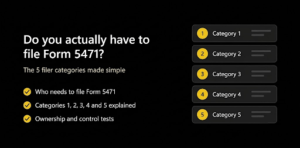
The Form 5471 filer categories determine which schedules and information you must provide. You may fall into several categories and must satisfy all applicable requirements without duplicating information.
Before reviewing the categories, write down your ownership percentages, acquisition dates, and officer or director appointments. Keep those details nearby as you read. They make the rules easier to connect to your circumstances.
Category 1: Certain Section 965 Shareholders
Category 1 concerns qualifying US shareholders of section 965 specified foreign corporations. Continuing reporting can apply while relevant section 965 earnings or previously taxed earnings remain reportable.
If earlier returns included section 965 reporting, bring them to your adviser. Ask specifically whether any remaining balances require attention. This category is easy to overlook when you focus only on what happened during the current year.
Category 2: Officers and Directors
Form 5471 Category 2 generally applies to a US citizen or resident serving as an officer or director when a US person acquires shares reaching 10% ownership by vote or value, or acquires an additional qualifying 10% interest.
You do not necessarily need to own shares yourself. For example, a US director may have a reporting obligation following another US person’s qualifying acquisition. Exceptions can apply.
Keep appointment dates and shareholder changes together. Your job title alone does not tell the whole story; your adviser needs the transaction timeline too.
Category 3: Share Acquisitions and Disposals
Form 5471 Category 3 generally covers US persons who:
- Acquire shares bringing ownership to at least 10% by vote or value.
- Acquire an additional qualifying 10% interest.
- Become a US person while holding at least 10%.
- Dispose of shares so ownership falls below 10%.
Special insurance-related rules also exist.
For example, increasing an interest from 6% to 12% can trigger acquisition reporting. Selling down from 12% to 8% can trigger disposal reporting. These examples assume no applicable exception.
Prepare records for purchases, sales, gifts, and other transfers rather than relying solely on your year-end percentage.
Category 4: Control of a Foreign Corporation
Form 5471 Category 4 concerns US persons controlling a foreign corporation. Control generally means owning more than 50% of its voting power or share value at any time during the relevant tax year, including applicable indirect and constructive ownership rules.
If your business has several companies in its ownership chain, sketch the structure for your preparer. Include each company’s name and the interests connecting them. A clear ownership chart is more useful than describing everything as “my overseas business.”
Category 5: Controlled Foreign Corporation Shareholders
Form 5471 Category 5 generally concerns qualifying US shareholders of a controlled foreign corporation, or CFC. A CFC generally has more than 50% of its vote or value owned by qualifying US shareholders. The usual shareholder threshold is 10% by vote or value; timing rules and exceptions also apply.
Ask your adviser to review the other shareholders and relevant ownership dates. Looking only at your personal percentage may leave important questions unanswered.
Check Exceptions Before Making a Decision
The Form 5471 categories of filers include exceptions, such as certain constructive ownership situations and arrangements where another person reports the required information. However, relying on another filer may still require a statement with your return.
Do not assume another shareholder’s filing automatically covers you. Ask what documentation supports the exception and what you must attach.
The Form 5471 filing requirements generally follow your federal return’s deadline, including extensions, with a separate reporting package for each applicable corporation.
Get Help Understanding Your Filing Position
OptimizeTax offers expat tax preparation, Form 5471 preparation, and controlled foreign corporation compliance services. Its international services also address foreign partnerships and investment reporting.
If you’re unsure who needs to file Form 5471 within your ownership structure, contact OptimizeTax with your company records and previous returns. Start by confirming your categories and any exceptions, then build the reporting package around your actual circumstances.