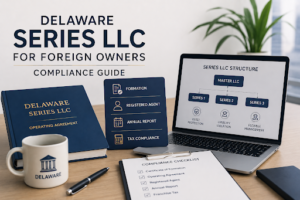
Delaware’s Series LLC allows you to create separate “cells” (series) within a single LLC — each with its own assets, liabilities, and members — without forming multiple entities. For foreign owners with multiple business lines, real estate investments, or IP portfolios, this structure offers liability separation without multiplying formation costs. But the compliance implications are poorly understood.
A Delaware foreign-owned LLC formed as a Series structure can multiply Delaware LLC form 5472 risk, complicate Delaware LLC compliance, and still raise Delaware franchise tax foreign owner questions.
**Short Answer:** A Delaware Series LLC can separate assets and liabilities across individual series, but it adds recordkeeping and filing complexity. Foreign owners should assume the IRS and advisors will expect more documentation, not less.
How Delaware LLC compliance changes in a Series structure
| Feature | Traditional LLC | Series LLC |
| Liability protection | One shield for entire entity | Separate shield for EACH series |
| Assets | All assets in one pool | Each series owns its own assets independently |
| Members | Same members for entire entity | Each series can have different members |
| Formation | One filing per entity | One filing creates the parent + unlimited series |
| State filing per series | N/A | No separate filing required for each series |
| Annual franchise tax | $300 (one entity) | $300 (one entity — not per series) |
| Bank accounts | One or more under same EIN | Can have separate accounts per series |
Key benefit: Instead of forming 5 separate LLCs ($90 × 5 = $450 formation + $300 × 5 = $1,500/year franchise tax), one Series LLC costs $90 formation + $300/year total franchise tax — regardless of how many series you create.
Common Use Cases for Foreign Owners
| Use Case | How Series LLC Helps | Example |
| Multiple real estate properties | Each property in its own series — lawsuit against one doesn’t reach others | Indian investor owns 3 US rental properties |
| Multiple e-commerce brands | Each brand isolated — product liability stays within that series | UAE entrepreneur runs 4 Amazon brands |
| IP portfolio management | Each patent/trademark in its own series | Singapore tech company licenses multiple products |
| Investment portfolio | Each investment isolated from others | UK family office with diverse US holdings |
| Multiple client projects | Each project’s liability contained | Nigerian agency with separate US client engagements |
Form 5472 Obligations: The Critical Question
This is where most foreign owners (and many CPAs) get confused. The IRS has NOT issued definitive guidance on whether each series requires its own Form 5472.
| Question | Current Guidance |
| Does each series file its own Form 5472? | Unclear — IRS has not issued specific Series LLC guidance |
| Does the parent LLC file one Form 5472 for all series? | Possibly — depends on how transactions are structured |
| Conservative approach | File one Form 5472 per series that has reportable transactions with foreign owners |
| Aggressive approach | File one consolidated Form 5472 for the parent entity |
| Our recommendation | **Conservative approach** — file per series to avoid penalty risk |
| Why conservative? | Each $25,000 penalty is per form. Under-reporting is worse than over-reporting. |
Practical Filing Approach
| Scenario | Recommended Filing |
| Parent series + 3 operating series, all same foreign owner | 1 Form 5472 per series with transactions (potentially 4 total) |
| Parent series only, no separate series active | 1 Form 5472 for the parent |
| 5 series, but only 2 had transactions with foreign owner | 2 Form 5472s (for the 2 active series) |
| Series with different foreign members | 1 Form 5472 per foreign related party per series |
Franchise Tax Advantage
| Structure | Annual State Cost | 5-Year Total |
| 5 separate Delaware LLCs | $300 × 5 = $1,500/year | $7,500 |
| 5 separate Wyoming LLCs | $60 × 5 = $300/year | $1,500 |
| 1 Delaware Series LLC (5 series) | $300/year (flat) | $1,500 |
Series LLC saves $1,200/year vs separate Delaware LLCs while maintaining the same liability isolation. However, it costs the same as 5 Wyoming LLCs. — so the advantage is specifically vs multiple Delaware entities.
Risks and Limitations for Foreign Owners
| Risk | Details | Mitigation |
| IRS uncertainty | No official guidance on Series LLC tax treatment | File conservatively (per-series Form 5472) |
| Cross-series commingling | If series assets are mixed, courts may “pierce” the series shield | Maintain strict separation of bank accounts and records |
| Banking difficulty | Many banks don’t understand Series LLCs and may refuse separate accounts per series | Use banks experienced with Series structures (Mercury may not support per-series accounts) |
| Other state recognition | Not all states recognize Delaware Series LLC liability shields | If doing business in other states, verify recognition |
| Limited case law | Few court decisions testing series liability separation | Structure is legally newer — less certainty than traditional LLCs |
| CPA expertise required | Most CPAs have never filed for a Series LLC | Use a CPA experienced with international + Series structures |
Series LLC vs Holding Company Structure
| Factor | Series LLC | Holding Company (Parent LLC + Subsidiary LLCs) |
| Formation cost | $90 (one entity) | $90 × N entities |
| Annual franchise tax | $300 total | $300 × N entities |
| Liability isolation | ✅ (if properly maintained) | ✅ (well-established in case law) |
| Banking per subdivision | Difficult (bank may not understand) | Easy (each subsidiary has its own EIN) |
| IRS clarity | ⚠️ Uncertain | ✅ Clear — each subsidiary files separately |
| Court precedent | Limited | Extensive |
| Investor comfort | Low (unfamiliar structure) | High (standard corporate structure) |
| Form 5472 clarity | ⚠️ Uncertain per-series requirements | ✅ Clear — each entity files its own |
Our recommendation: If you need absolute certainty on IRS treatment and investor/bank compatibility, the traditional holding company structure is safer. If cost savings is the priority and you can tolerate some ambiguity, Series LLC works well for asset-holding (real estate, IP) but poorly for operating businesses seeking investment.
Conservative filing approach for a Delaware Series LLC
A Series LLC can be cost-efficient on paper, but foreign owners should not assume that one filing answers every question. The safer approach is to treat each series as a potential compliance unit and document the facts accordingly.
| Recordkeeping area | Best practice |
| Bank accounts | Use separate accounts or at minimum separate ledgers for each series |
| Owner contributions | Track which series received the funding and when |
| Contracts | Sign in the name of the correct protected series |
| Assets | Keep titles, invoices, and schedules by series |
| Inter-series transfers | Document them like related-party movements |
Series-level review matrix
| Question | Master LLC | Individual series |
| Needs good standing and agent? | Yes | Indirectly through master structure |
| Needs transaction records? | Yes | Yes |
| Needs federal filing analysis? | Yes | Yes, especially if series is disregarded separately |
| Needs separate bookkeeping? | Strongly recommended | Strongly recommended |
Example structures where complexity grows quickly
| Structure | Why it becomes difficult |
| One series per rental property | Sale events and financing differ by property |
| One series for IP and one for operations | Related-party licensing and service charges must be documented |
| Different foreign owners in different series | Ownership and reportable transaction analysis can diverge |
The compliance risk is not just the form count. It is the chance that the documentation does not match the legal structure. If a foreign owner says each series is separate but commingles revenue, expenses, and contracts, the practical benefit of the structure weakens and the tax review becomes harder.
That is why many advisors take a conservative approach on foreign-owned Series LLCs. Even when the law allows a flexible structure, the filing and documentation standard should be treated as stricter than a plain single-member LLC. This is especially true when real estate, licensing income, or cross-border funding is involved.
Authoritative Sources
- [IRS Form 5472 Instructions](https://www.irs.gov/forms-pubs/about-form-5472)
- [IRS Form 1120 Information](https://www.irs.gov/forms-pubs/about-form-1120)
- [IRS FBAR Requirements](https://www.irs.gov/businesses/small-businesses-self-employed/report-of-foreign-bank-financial-accounts-fbar)
- [Delaware Division of Corporations](https://corp.delaware.gov/)
Frequently Asked Questions
How many series can I create under one Delaware Series LLC?
Unlimited. You can create as many series as needed without additional state filings or franchise tax increases. Each new series simply requires documentation in the operating agreement.
Does each series need its own EIN?
The IRS has not required separate EINs for each series, but some banks require it for separate accounts. In practice, most Series LLCs operate under a single EIN with detailed internal accounting per series.
Is a Series LLC good for foreign real estate investors?
Yes — this is one of the strongest use cases. Each property in its own series provides liability isolation (lawsuit on Property A doesn’t reach Property B) while keeping compliance costs at one $300/year franchise tax payment.
Can I convert my existing Delaware LLC to a Series LLC?
Yes, by amending your Certificate of Formation to include series provisions and updating your operating agreement. This does not require forming a new entity or obtaining a new EIN.
Does OptimizeTax handle Form 5472 for Series LLCs?
Yes. We take the conservative approach — filing per series that has reportable transactions with foreign owners. This protects you from per-form penalties until the IRS provides clearer guidance.
Does a Delaware foreign owned LLC in series form still need Delaware LLC form 5472?
Yes. A Delaware foreign owned LLC in series form can still trigger Delaware LLC form 5472 obligations, and each series should be reviewed conservatively.
Is there a Delaware LLC annual report for a Series LLC?
No. There is no Delaware LLC annual report, but Delaware LLC compliance still includes state tax, agent maintenance, and entity-level recordkeeping.
Can a foreign owned C corporation own a Series LLC?
Yes, but a foreign owned C corporation ownership chain adds another layer of tax and reporting analysis that should be reviewed before implementation.