Starting a business abroad often means learning a new set of local rules. You register the company, arrange its accounts, and work with a local accountant. Then an unfamiliar US tax form comes up: Form 5471.
It’s understandable to wonder why the IRS needs information about a business operating overseas. Understanding Form 5471 for US expats begins with your relationship to the company, including ownership and management roles. Certain US citizens and residents who are shareholders, officers, or directors of foreign corporations have reporting obligations. Living abroad does not automatically remove them.
Form 5471 Explained in Plain English
Form 5471 is an information return used to report certain US persons’ interests in foreign corporations. Its accompanying schedules give the IRS details about the company and relevant shareholder activities.
Think of it as a reporting package rather than a simple declaration that you own a business. Depending on the applicable requirements, information can include shareholders, financial statements, foreign taxes, distributions, and transactions with related parties. Different schedules address different subjects.
Having Form 5471 explained clearly helps you ask better questions before filing. Start with whether reporting applies, then establish which information your situation requires.
Who Needs to File Form 5471?
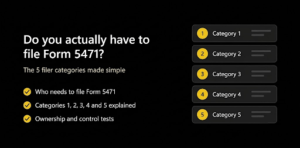
The answer to who needs to file Form 5471 depends on specific IRS filer categories. Common situations requiring review include:
- Officers or directors: Certain US citizens or residents must report when a US person makes a qualifying stock acquisition.
- Share acquisitions or disposals: Reporting can arise when ownership reaches 10% by vote or value, additional qualifying shares are acquired, or ownership falls below 10%.
- Controlling owners: Category 4 generally concerns US persons with more than 50% ownership by vote or value.
- Controlled foreign corporation shareholders: Category 5 concerns qualifying US shareholders of controlled foreign corporations, subject to ownership and timing rules.
These are starting points, not a complete eligibility checklist. Indirect ownership, constructive ownership, overlapping categories, and filing exceptions also matter. Simply owning 10% does not establish an identical annual filing obligation for every shareholder.
For US expat foreign corporation owners, a useful first step is preparing an ownership timeline. Record when you acquired shares, changes in your percentage, and your roles within the business.
What Information Should You Gather?
Preparing early makes foreign corporation reporting requirements easier to manage. Depending on your circumstances, gather:
- Incorporation details and the company’s accounting period.
- Shareholder names, share classes, and ownership records.
- Income statements and balance sheets.
- Details of shareholder loans and other related-party transactions.
- Foreign tax records and distribution information.
Form 5471 includes shareholder reporting, an income statement, and a balance sheet. Its instructions also specify accounting and currency translation requirements; local accounts may need adjustments before figures are reported.
Ask your local accountant for supporting records well before your US filing deadline. Explain that you need information for US reporting, so both advisers can identify missing details early.
When Is Form 5471 Due?
The Form 5471 filing requirements generally call for attaching the completed form and applicable schedules to your federal income tax return. It follows that return’s due date, including applicable extensions. A separate reporting package is generally required for each foreign corporation.
Avoid assuming that your company’s local filing deadline determines your US deadline. Coordinate both calendars and confirm the relevant accounting period with your preparer.
What Happens If You Miss the Filing?
Penalties can be substantial. Under section 6038, failure to provide required information can trigger a $10,000 penalty per corporation per annual accounting period. Additional penalties can accrue after an IRS notice if the failure continues. Separate transaction-reporting penalties may apply under section 6046.
If you discover an omission, gather the affected returns and company records before seeking advice. Explain what was missed and whether you have received IRS correspondence. That gives your adviser a clearer basis for reviewing corrective steps.
How OptimizeTax Helps Americans Abroad
OptimizeTax offers expat tax preparation and international reporting services, including Form 5471 preparation, controlled foreign corporation compliance, foreign tax credit analysis, and cross-border tax planning. Its website also lists foreign partnership and investment reporting services for more complex situations.
Professional support with Form 5471 for Americans abroad starts with understanding the whole picture. Share your ownership history, company accounts, previous US returns, and specific concerns rather than focusing only on completing one form.
If you’re unsure about Form 5471 for US expats, contact OptimizeTax to discuss your foreign business interests. An early review can help you identify the reporting questions to resolve and the records to prepare before filing.