Delaware’s franchise tax is the single most confusing state-level obligation for foreign owners. It’s not an income tax. It’s not related to Form 5472. It’s a separate annual fee that Delaware charges simply for the privilege of being a Delaware entity. This guide explains what you owe, when to pay, and how to avoid the $75,000+ overbilling trap that catches thousands of C-Corp founders every year.
Whether you run a Delaware foreign owned LLC or a foreign owned C corporation, Delaware LLC compliance and annual state deadlines must be tracked separately from federal tax filings.
**Short Answer:** Delaware franchise tax is a state maintenance charge, not an income tax. Foreign owners of Delaware entities must pay it on time and still complete separate IRS filings such as Form 5472 when required.
What Delaware franchise tax foreign owner bills actually cover
| Common Question | Answer |
| Is it an income tax? | No — it’s charged regardless of revenue or profit |
| Does it relate to Form 5472? | No — franchise tax is state (Delaware); Form 5472 is federal (IRS) |
| Can I avoid it? | No — if you maintain a Delaware entity, you owe it annually |
| What triggers it? | Simply existing as a Delaware entity triggers the obligation |
| What happens if I don’t pay? | Your entity loses good standing and may be voided |
| Is it deductible? | Yes — as a business expense on your tax return (if applicable) |
Delaware Franchise Tax: LLC vs C-Corp
The franchise tax works completely differently depending on your entity type:
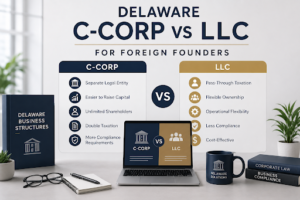
| Factor | Delaware LLC | Delaware C-Corp |
| Annual amount | $300 flat fee | $400 minimum — up to $200,000+ |
| Calculation method | None — flat fee regardless of size | Two methods (Authorized Shares or Assumed Par Value) |
| Due date | June 1 | March 1 |
| Annual report required? | No | Yes (filed with franchise tax) |
| Late penalty | $200 + 1.5%/month interest | $125 late fee + $200 penalty + 1.5%/month |
| Complexity | Simple — just pay $300 | Complex — wrong method can cost $75,000+ |
For LLC Owners: It’s Simple
If you have a Delaware LLC, your franchise tax is straightforward:
| What | Details |
| Amount | $300/year — no exceptions, no variables |
| Due date | June 1 every year |
| How to pay | Online at Delaware Division of Corporations (corp.delaware.gov) |
| First payment | Due June 1 of the year AFTER formation |
| Late fee | $200 penalty + 1.5% monthly interest |
| What to remember | This is separate from Form 5472 — you owe both |
That’s it. For LLCs, there’s no calculation, no election, no confusion. Pay $300 by June 1 every year. Done.
For C-Corp Owners: The $75,000 Trap
This section is critical for foreign founders who formed a Delaware C-Corp through Stripe Atlas, Firstbase, Clerky, or similar platforms. Delaware calculates C-Corp franchise tax using two methods — and the default method can produce bills 100x higher than necessary.
Method 1: Authorized Shares Method (THE TRAP)
This is Delaware’s default method. It calculates tax based purely on how many shares you authorized:
| Authorized Shares | Annual Franchise Tax |
| 5,000 or fewer | $175 |
| 5,001 — 10,000 | $250 |
| Each additional 10,000 shares | +$85 |
| 10,000,000 shares (typical startup) | ~$75,000+/year |
Why this traps foreign founders: Most startup attorneys authorize 10,000,000 shares (standard for VC fundraising). Delaware’s default calculation turns this into a $75,000+ annual bill — even if the company has $0 in revenue and $500 in the bank.
Method 2: Assumed Par Value Capital Method (THE FIX)
This method calculates tax based on actual assets and issued shares, not authorized shares:
| Factor | How It Works |
| Calculation basis | Total gross assets ÷ total issued shares = assumed par value |
| Typical result | $400 — $500/year for most startups |
| How to elect | Provide total gross assets on your annual report (filed by March 1) |
| Who should use it | ANY C-Corp with more than 5,000 authorized shares |
| Savings | Reduces $75,000+ bills to $400-500 in most cases |
Side-by-Side Example
| Scenario | Authorized Shares Method | Assumed Par Value Method |
| 10M authorized shares, $50,000 gross assets, 1M issued shares | $84,975/year | ~$400/year |
| 10M authorized shares, $500,000 gross assets, 2M issued shares | $84,975/year | ~$450/year |
| 10M authorized shares, $5M gross assets, 5M issued shares | $84,975/year | ~$1,200/year |
In every scenario, the Assumed Par Value method produces a dramatically lower bill. There is virtually no situation where a startup should use the Authorized Shares method.
How to Fix an Overbilling
If you already received a massive franchise tax bill:
| Step | Action | Timeline |
| 1 | Do NOT pay the inflated bill | Immediately |
| 2 | Calculate your tax using Assumed Par Value method | 1-2 days |
| 3 | File your annual report with total gross assets included | Before March 1 deadline |
| 4 | Delaware recalculates using the lower method | Automatic after filing |
| 5 | Pay the correct (lower) amount | After recalculation |
| 6 | If you already overpaid, request a refund | Contact Delaware Division of Corporations |
⚠️ Important: You must elect the Assumed Par Value method by filing your annual report WITH gross assets listed. If you file the annual report without gross assets, Delaware defaults to the Authorized Shares method.
Franchise Tax vs Form 5472: Separate Obligations
Foreign owners frequently confuse these two requirements. They are completely independent:
| Delaware Franchise Tax | Form 5472 | |
| Authority | Delaware Division of Corporations | IRS (federal) |
| Purpose | Annual fee for being a Delaware entity | Report transactions with foreign owner |
| Amount / Penalty | $300 LLC / $400+ C-Corp | $25,000 penalty per year missed |
| Due date | June 1 (LLC) / March 1 (C-Corp) | April 15 / October 15 |
| Triggered by | Forming a Delaware entity | Being a foreign owner of any US entity |
| Relationship to each other | None — completely independent | None — completely independent |
You must satisfy BOTH obligations. Paying franchise tax does not satisfy Form 5472, and vice versa.
Authoritative Sources
- [IRS Form 5472 Instructions](https://www.irs.gov/forms-pubs/about-form-5472)
- [IRS Form 1120 Information](https://www.irs.gov/forms-pubs/about-form-1120)
- [IRS FBAR Requirements](https://www.irs.gov/businesses/small-businesses-self-employed/report-of-foreign-bank-financial-accounts-fbar)
- [Delaware Division of Corporations](https://corp.delaware.gov/)
Frequently Asked Questions
I have a Delaware LLC. Is my franchise tax $300 or more?
For LLCs, it’s always $300 — flat fee, no variables. The complex calculations only apply to C-Corps.
I formed my Delaware C-Corp through Stripe Atlas. What should I do about franchise tax?
File your annual report by March 1 and include your total gross assets. This automatically elects the Assumed Par Value method. Without this, you’ll receive a bill based on authorized shares ($75,000+ for most startups).
Can I avoid Delaware franchise tax by not conducting business?
No. Franchise tax is charged for the privilege of existing as a Delaware entity, not for conducting business. The only way to stop franchise tax is to formally dissolve or convert your entity.
What happens if I don’t pay Delaware franchise tax?
After 2 years of non-payment, Delaware will void your entity. This means your company ceases to legally exist. Reinstatement requires paying all back taxes plus penalties. Bank accounts, contracts, and investments may be affected immediately upon voiding.
Does my Form 5472 CPA handle franchise tax?
It depends on your CPA. At OptimizeTax, we provide franchise tax advisory (especially the Assumed Par Value election) and reminders as part of our Delaware service package. The payment itself is a simple online transaction you make directly.
Does a Delaware foreign owned LLC pay Delaware franchise tax foreign owner charges every year?
Yes. A Delaware foreign owned LLC pays the annual state LLC tax even though there is no Delaware LLC annual report for LLCs.
Is Delaware LLC form 5472 included in the franchise tax payment?
No. Delaware LLC form 5472 is a separate federal filing and is not handled through Delaware’s state tax portal.
Does a foreign owned C corporation calculate franchise tax differently?
Yes. A foreign owned C corporation uses Delaware’s corporate franchise tax methods, which can produce very different bills from the flat-fee LLC regime.