Approval of foreign companies in the US is a very complicated and expensive issue because they have stricter IRS reporting rules than domestic companies. Moreover, the owners are often startled to find that the reporting requirements apply even if their company earns very little or no income at all. Among the various forms filed in this regard, Form 1120 and Form 5472 are the two most significant ones. It is imperative to know the dissimilarity between these forms to be compliant and to evade expensive fines.
Mistakes in foreign owned LLC reporting and taxes are typical since owners think that these forms are optional or that they are required only when there is a tax to be paid. In fact, these filings are mandated according to the ownership and transaction activities rather than the profitability of the business.
Understanding Form 1120 Filing Requirements
Form 1120 is the U.S. Corporation Income Tax Return. It is required for C Corporations operating in the United States, including corporations that are wholly or partially foreign-owned.
Key Form 1120 filing requirements include reporting:
- Gross income earned during the tax year
- Business expenses and deductions
- Taxable income or loss
- Corporate tax liability
- Balance sheet and financial activity
Even for foreign-owned companies, the Form 1120 is a must-have document that should be submitted even if there was no income generated by the firm. A return with no income is still a prerequisite of the filing, and if it is not, the IRS might impose penalties as a consequence.
This form establishes the company’s official tax position with the IRS and is the foundation for compliance at the corporate level.
What Is Form 5472 and Why Does It Matter
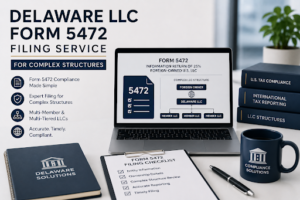
Form 5472 is an informational return required for U.S. companies with foreign ownership that engage in reportable transactions with related foreign parties.
The Form 5472 filing requirements apply to:
- Foreign-owned U.S. corporations
- Single-member LLCs are treated as disregarded entities with foreign owners
- Companies involved in transactions with foreign shareholders or related entities
Reportable transactions may include capital contributions, loans, management fees, reimbursements, or any financial exchange between the U.S. entity and its foreign owner.
Even if there is no income, Form 5472 must still be filed if these transactions occurred.
How Form 1120 and Form 5472 Work Together
Many foreign-owned companies are required to file both forms. This often causes confusion.
Here is how they typically work together:
- The overall financial performance of the company is presented in Form 1120.
- Form 5472 reveals details about particular transactions with foreign owners.
- Form 5472 accompanies Form 1120, and hence both are filed together.
- Each form has to be sent in by the deadline for it to be applicable.
Pro forma Form 1120 is usually necessary just for the sake of attaching Form 5472 in the case of foreign-owned single-member LLCs, even if the LLC is treated as a disregarded entity for income tax purposes.
This dual reporting is one of the most misunderstood aspects of foreign-owned LLC reporting and taxes.
Common Mistakes Foreign-Owned Companies Make
Foreign business owners frequently run into trouble due to misunderstanding IRS expectations. Some of the most common issues include:
- Thinking that no income equals no tax return
- Not submitting Form 5472 along with Form 1120
- Wrongly reporting transactions between related parties
- Filing late because of not knowing the U.S. due dates
- Wrongly classifying the business type
These errors can result in significant penalties. The penalty for failing to file Form 5472 alone can reach tens of thousands of dollars per year, even if no tax is owed.
Why Professional Support Is Critical
The tax compliance of foreign-owned companies in the USA is not limited to merely submitting papers. It requires comprehending the entity structure, ownership regulations, transfer pricing principles, and the expectations of the IRS regarding disclosures.
Professional guidance helps ensure:
- Correct determination of filing obligations
- Accurate reporting of related-party transactions
- Timely submission of all required forms
- Proper documentation to support IRS compliance
- Reduced risk of audits and penalties
This is especially important for companies operating across borders or managing funds between countries.
Planning Beyond Compliance
The correct filing of Forms 1120 and 5472 is just the beginning. Properly executed strategic planning can assist foreign-owned companies in their dealings, cash flow control, and staying on the right side of the law for a long time.
Ongoing tax planning supports:
- Transaction documentation gets better
- Reporting consistency is improved
- Compliance risk is reduced
- Business stability for the long term
Conclusion
To be a foreign-owned company in the U. S., you would need to comprehend the Form 1120 filing requirements, Form 5472 filing requirements, and the complete picture of foreign-owned LLC tax and reporting. The submission of these forms is mandatory, and even when there is no tax liability, errors can still be expensive. Partnering with professionals who have vast experience brings precise filings, correct disclosures, and a worry-free state. For trustworthy compliance and top-notch counsel customized to the foreign-owned U. S. market, count on OptimizeTax.